
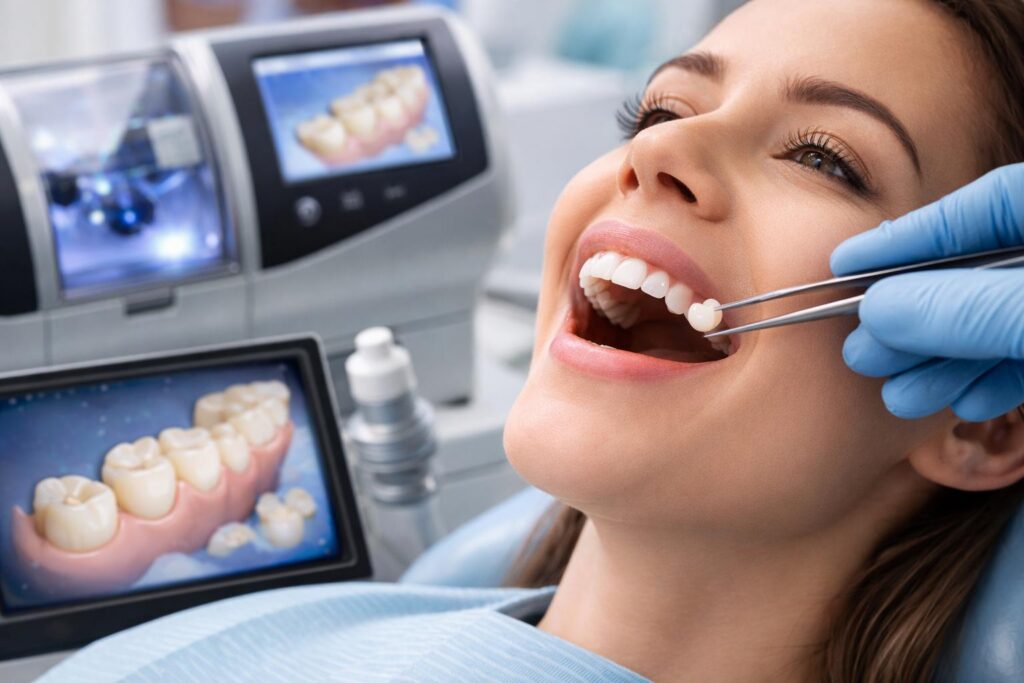
You cracked a molar and your dentist says you need a crown. Now you have a choice. You can walk out with a finished crown today, or wear a temporary for a couple of weeks and come back for a lab-made one.
What’s the real difference between same-day and traditional crowns?
Both crowns cap your prepared tooth and restore its shape and strength. The two methods differ in how the crown comes together. For a CEREC crown, your dentist scans, designs, and mills it in the office in one visit. A traditional crown uses an impression sent to an outside lab, where a technician builds it over one to two weeks while you wear a temporary. Same result, two paths.
At Scripps West Dental in Mira Mesa, Dr. James Tasto, DDS, offers both. He earned his DDS at USC with a focus on cosmetic and restorative dentistry, and he places the final restoration on the implant and crown cases the team handles in-house. That matters here, because the right crown depends on your tooth, not on which method sounds newer.
CEREC stands for Chairside Economical Restoration of Esthetic Ceramics. The name is a mouthful. The idea is simple. The machine does in one appointment what a lab does over two weeks.
What to know before you choose
- A CEREC crown takes one visit of about two to three hours, with no temporary and no second trip.
- A traditional crown needs two visits spaced one to two weeks apart, and you wear a temporary in between.
- Both types survive at similar rates for a back tooth, with well-made crowns lasting 10 to 15 years or longer.
- Front teeth, heavy grinding, and complex cases often do better with a lab crown and its wider material choices.
- Book an exam so your dentist can match the method to the specific tooth before you commit.
How long does each crown take?
A CEREC crown takes a single appointment of about two to three hours. A traditional crown takes two visits over one to two weeks, with a temporary crown in between. So the honest headline is time, not quality. If a second weekday visit is hard to arrange, the one-appointment route removes that problem.
Plan for a longer chair time on a CEREC day than a routine filling. First you get numb and your dentist prepares the tooth. Then the scanner captures a 3D image, the software designs the crown, and the milling unit carves it while you wait. It is still one day. It is not a quick 45 minutes.
The traditional route splits that work across two shorter visits. Some people prefer the gap. It gives time to process the cost or settle nerves before the final crown goes in. Neither pace is wrong. It depends on your week and your comfort.
Which crown lasts longer?
Neither method wins clearly on longevity. Research on both types shows similar five-year survival for a back tooth, and well-made crowns of either kind commonly last 10 to 15 years. A 10-year study of CEREC restorations published in the journal Clinical Oral Investigations reported a five-year survival rate of about 95 percent. What shortens a crown’s life is rarely the machine that made it.
A 2007 systematic review in the Journal of Prosthetic Dentistry put five-year survival of all-ceramic single crowns near 93 percent, close to metal-ceramic crowns at about 96 percent. Those numbers sit in the same neighborhood as milled ceramic.
Three things drive crown life: grinding, how much healthy tooth remains to support the crown, and daily brushing and flossing. A well-cared-for lab crown lasts a long time. A neglected same-day crown does not. Your habits outweigh the fabrication method.
Same-day and lab crowns also tend to fail in different ways when they do. Milled ceramic is slightly more likely to fracture or debond. Older porcelain-fused-to-metal crowns more often chip at the porcelain or develop decay at the edge. Neither pattern is common, and it usually shows up years down the line rather than early.
The material milled into a CEREC crown matters more than the word “same-day.” A 2025 multicenter trial found lithium disilicate chairside crowns reached very high five-year survival, while some hybrid ceramics fared worse. So the question worth asking your dentist is not “lab or chairside,” but “which ceramic are you using for my tooth.” That answer shapes durability far more than the machine.
Do same-day crowns fit as well as lab crowns?
Same-day crowns fit within the range dentists consider clinically acceptable, and so do lab crowns. Both land under the roughly 120-micrometer marginal gap that counts as a good seal. A micrometer is one-thousandth of a millimeter, far thinner than a hair. The fit gap between the two methods is smaller than the ads suggest.
Two things drive fit: how well your dentist prepares the tooth and how accurate the scan or impression turns out. A careful scan and a skilled hand matter more than the label on the process. A good lab technician with a clean impression can match or beat a milled result, and a strong digital scan can match a lab.
Where lab crowns still pull ahead
Lab crowns hold an edge on front teeth and on customization. A natural front tooth has translucency at the edge, warmth near the gum, and small light-catching details. A technician can hand-layer and stain porcelain to copy the tooth beside it. Milling that subtlety from a single ceramic block is hard.
Lab crowns also open up more materials. Gold does not look natural, but it is gentle on the opposing teeth and holds up under heavy load. That makes it a common pick for a back molar or for someone who grinds. Porcelain-fused-to-metal is another lab-only option.
The mill carves a CEREC crown from one block of lithium disilicate or zirconia. Both are strong and tooth-colored, which makes them a solid choice for molars that take real chewing force and do not show when you smile. For a back tooth in a healthy mouth, a milled crown is often all you need.
Same-day vs traditional crowns compared
Here is how the two methods line up on the factors patients ask about most.
| Factor | CEREC same-day | Traditional lab |
| Visits | One | Usually two |
| Time frame | 2 to 3 hours | 1 to 2 weeks |
| Temporary crown | Not needed | Yes, while you wait |
| Fit | Clinically excellent | Clinically excellent |
| Front-tooth look | Good | Often better, hand-layered |
| Material options | Ceramic blocks | Full range, incl. gold and PFM |
| Typical lifespan | 10 to 15+ years | 10 to 15+ years |
| Best for | Back teeth, tight schedules | Front teeth, grinders, complex cases |
The table is a starting point. Your dentist’s read on your specific tooth still decides the best route.
What does a crown cost in San Diego?
A crown in the San Diego area typically runs about $1,000 to $2,500 without insurance, depending on the tooth and material. Most dental plans treat a crown as a major procedure and cover roughly 50 percent after your deductible, which drops the out-of-pocket cost to about $500 to $1,250 until you hit your annual maximum.
Choosing CEREC over a lab crown usually does not change what insurance pays. Plans reimburse a crown by material and clinical need, not by the place that built it. The equipment cost of a CEREC system tends to offset the lab fee, so the two land in a similar price range. The main saving is a second trip, not the bill itself.
If you have already used up your annual maximum for the year, or you have no dental insurance, the full fee lands on you either way, no matter which method makes the crown. Some people in that spot ask about a dental savings membership or a financing plan to spread the cost. Those options do not change the crown itself, only how you pay for it.
Because prices shift by tooth, material, and plan, the fair way to compare is a written estimate for your exact case. Our front desk can check your benefits before treatment so you see the real number first.
Does getting a crown hurt?
Getting a crown is not more painful one way or the other. Your dentist prepares the tooth the same way for both, using local anesthetic, so you feel pressure but not pain. Mild sensitivity for a few days afterward is normal and eases with over-the-counter pain relief. The day-of difference is comfort, not pain level.
A CEREC visit skips the temporary crown and the second numbing appointment. A temporary can feel loose or sensitive during the wait, and a small number come off early. Removing that step is one reason people with a strong gag reflex or a busy calendar lean toward same-day care.
Getting a crown in Mira Mesa
If a molar in Mira Mesa feels cracked, worn, or achy, book an exam so a dentist can look at the tooth and talk through your options honestly. Scripps West Dental serves Mira Mesa and nearby San Diego communities including Scripps Ranch and University City, and the practice keeps same-day emergency slots open Monday through Thursday.Scripps West Dental is at 9420 Mira Mesa Blvd, Suite D, and you can reach the front desk at (858) 695-1776 to ask about a crown, check your coverage, or book a visit with Dr. James Tasto, DDS. Bring your questions. A short conversation about your tooth beats guessing from an ad.