
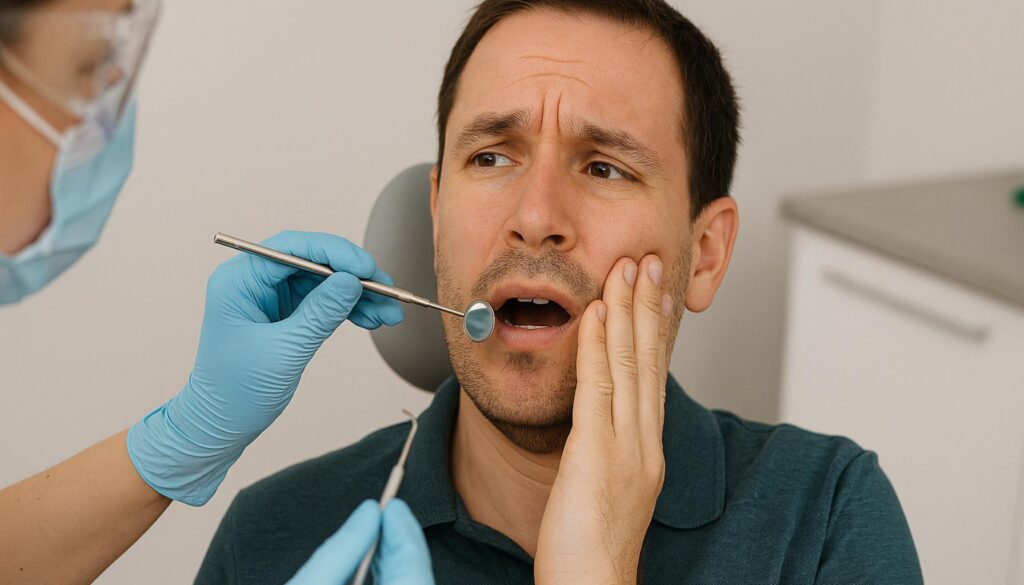
Tooth pain has a way of showing up at the worst time, then talking you into ignoring it. Maybe it fades by morning. Maybe a cold drink still makes you wince days later.
A root canal is the treatment a dentist uses to save a tooth when the soft tissue inside it, called the pulp, gets infected or inflamed. The most common signs are a toothache that will not quit, lingering hot or cold sensitivity, and swollen gums near one tooth. Left alone, that infection tends to spread, not settle. Catching it early usually means an easier fix.
At Scripps West Dental in Mira Mesa, our team includes an endodontist, Dr. Joel Altshul, DMD, who trained in endodontics after dental school and has spent decades diagnosing tricky tooth pain. That matters, because the hard part is often knowing what the pain means.
What to know if a tooth keeps bothering you
- Pulp infection does not heal on its own. It needs treatment to clear.
- The clearest early signs are lasting pain, lingering temperature sensitivity, and gum swelling near one tooth.
- The American Association of Endodontists reports dentists complete more than 15 million root canals in the U.S. each year to save natural teeth.
- Waiting often turns a root canal into an extraction, which is a bigger job to fix.
- Call a dentist within a few days of steady tooth pain, and the same day if your face swells.
What does a root canal actually treat?
A root canal treats an infected or inflamed pulp, the soft core of nerves and blood vessels inside your tooth. When decay, a crack, or an injury lets bacteria reach that pulp, it cannot recover. Your dentist removes the damaged tissue, cleans the space, and seals it. Root canal treatment clears the bacteria and keeps your natural tooth in place.
People often worry that losing the pulp means losing the tooth. It does not. The pulp helps a tooth grow, but a grown tooth works fine without it. That is why removing the infected pulp saves the tooth instead of ending it.
Bacteria reach the pulp in a few common ways. Deep decay is the usual one. A cracked or chipped tooth can open a path, and so can a tooth that took a hard hit years ago. Once the pulp is infected, the American Association of Endodontists notes it can lead to an abscess if nobody treats it.
The warning signs worth watching for
Not every ache means a root canal. Still, a few patterns tend to point that way, especially when more than one shows up in the same tooth. Here are the ones we tell Mira Mesa patients to take seriously.
A toothache that lingers or keeps returning
Pain that sticks around for days, or keeps coming back to the same tooth, is worth a call. It might throb, or it might flare when you chew. A quick twinge that vanishes is usually nothing. Pain you keep noticing is the kind to check.
Hot or cold sensitivity that hangs around
A brief zing from ice cream is normal. Sensitivity that lasts 30 seconds or more after the hot or cold is gone is not. That lingering reaction can mean the nerve inside the tooth is inflamed or starting to die.
Swollen gums or a bump near one tooth
Gums do not swell for no reason. Tenderness around a single tooth, or a small pimple-like bump on the gum, can signal an abscess draining underneath. A bad taste that keeps returning often comes from the same source.
A tooth that turns gray or dark
When one tooth slowly darkens while its neighbors stay the same, the pulp inside may be dying. This looks different from coffee or wine stains, which touch many teeth at once. A single dark tooth is worth an exam, even when it does not hurt.
Pain when you bite down
Sharp pain the moment you bite, or when you tap the tooth, often points to trouble at the root. If one specific tooth hurts under pressure while the rest feel fine, that tooth is telling you something.
Is it a root canal problem or just a sensitive tooth?
The difference usually comes down to time. Normal sensitivity is quick and fades once the trigger is gone. Root canal pain lingers, returns on its own, or wakes you at night. Pain that spreads to your jaw or ear, or that over-the-counter medicine barely touches, leans toward infection. Only an exam and X-ray can confirm it.
Here is the part people miss. Sometimes bad tooth pain fades on its own, and that feels like good news. It often is not. A nerve can die and go quiet while the infection keeps working below the surface. Relief without treatment does not mean the problem left.
When you are not sure which kind of pain you have, treat lasting or repeat pain as a reason to get checked rather than a reason to wait it out.
Why does waiting make a root canal worse?
Waiting gives a tooth infection room to grow. The bacteria move from the pulp into the bone around the root, and that bone can start to break down. A tooth that was treatable can reach a point where nobody can save it. Then the choice becomes extraction, plus the work of replacing the tooth later.
The risk is not only local. The Centers for Disease Control and Prevention notes that untreated oral infections can affect overall health and daily life, not just one tooth. A problem that starts small does not stay small on its own.
There is a money side too. A root canal and a crown, done early, is a smaller project than pulling the tooth and adding an implant or bridge. The American Dental Association supports keeping natural teeth when it makes sense, and early care keeps that option open. Acting sooner protects both the tooth and your wallet.
When is a tooth infection an emergency?
Some symptoms mean you call today, not next week. Swelling that spreads across your face or jaw, a fever with tooth pain, or trouble swallowing or breathing all point to an infection on the move. Trouble opening your mouth, or a hot lump under the jaw, belongs in that same group. The Mayo Clinic lists facial swelling and fever among the warning signs of a tooth abscess that needs prompt care.
A spreading dental infection is not something to sleep on. In rare cases it reaches other parts of the body, which is why swelling and fever earn a same-day call. If you cannot reach us and symptoms get worse fast, an urgent care center or emergency room is the right move. For dental swelling during our hours, call and ask for a same-day emergency visit.
What you can do before your appointment
Home steps can ease the wait, but they do not treat the infection. Rinse with warm salt water a few times a day to calm sore gums. Over-the-counter pain relief can help, taken as the label directs. A cold compress on your cheek can bring swelling down.
Skip the heating pad on your face, since heat can pull swelling outward. Do not lean on leftover antibiotics either. Antibiotics may quiet an infection for a bit, but they cannot clean out the tooth, so the problem returns. The real fix is an exam and treatment, not a workaround.
Common questions about root canals
How long can you wait to get a root canal?
There is no safe countdown, because a pulp infection only grows. Some people wait days or weeks and the tooth is still treatable, while others lose that window sooner. Steady pain deserves a call within a few days. Facial swelling or fever means the same day. The earlier the exam, the more likely the tooth survives.
Does a root canal hurt?
Your dentist numbs the area with local anesthesia first, so the visit usually feels close to getting a filling. The American Association of Endodontists reports patients are six times more likely to call a root canal painless than a tooth extraction. Mild soreness for a day or two afterward is normal and eases with over-the-counter relief.
Will the tooth need a crown afterward?
Most back teeth need a crown after a root canal, since the tooth turns brittle once the pulp is gone. A crown caps it and brings back normal biting strength. At our Mira Mesa office, a crown made in one visit with CEREC technology can protect the tooth quickly, without a second appointment.
Getting a root canal in Mira Mesa
If a tooth in your Mira Mesa household has been aching, an exam is the fastest way to real answers. Scripps West Dental keeps a general dentist, a periodontist, an endodontist, and an oral surgeon under one roof, so most of what a sore tooth might need happens in one place. Our endodontist, Dr. Joel Altshul, DMD, focuses on diagnosing tooth pain and root canal care. That mix saves referrals and repeat trips across San Diego.When a treated tooth needs a crown, our office can make one in a single visit, so the tooth spends less time exposed. Call Scripps West Dental at (858) 695-1776 to request an appointment, and our front desk can walk you through payment options.